November 16th, Budapest. It is 2-2 at the Ferenc Puskás Arena and Ireland are desperately pushing to find a late winner against Hungary to keep their World Cup hopes alive. With the clock ticking over to the final minute of stoppage time, Caoimhín Kelleher launches it forward. His long ball is flicked on to Troy Parrott who arrives at the far post to prod the ball in the back of the net.
The stadium falls silent and a small group of away fans rises to celebrate what since then has been coined the “miracle of Budapest”. With that historic winning goal, Parrott completed his hat-trick, becoming the first Irishman to do so in an away match.
What is seen in Ireland as one of the national team’s greatest modern achievements is being viewed as one of the biggest disasters in Hungarian football and, potentially, a blow to Viktor Orban’s re-election hopes next April.
Given that billions of euros have been funnelled into the sport over the last 15 years by his increasingly authoritarian Hungarian government, World Cup qualification had shifted from a distant dream to an expectation in supporters’ minds.
READ MORE


Given that football has been used as a political vehicle by Orban’s ruling Fidesz party, Ireland’s unlikely victory did more than just end a qualifying campaign: it punctured the government’s narrative of national resurgence through the sport in advance of the general election.
Tom Mortimer, who has been covering Hungarian football for more than 15 years, says the loss to Ireland felt like the collapse of the government’s grand footballing project.
“It felt like a national mourning. Since Orban took over for a second time it felt like all the paths were leading to this moment to get to the World Cup.”
Since Orban’s return to power in 2010, his government has made it one of its primary objectives to revive the spirit of the “Mighty Magyars” of the 1950s and restore Hungary as a dominant force in European football.
Orban, a close ally of Donald Trump and Vladimir Putin, has leveraged football as a tool to cultivate his soft power and distract from domestic issues. By building national pride on the terraces, he has attempted to create a political buffer against growing discontent over an ever-growing cost-of-living crisis.
For more than 15 years, the Fidesz-led government has funnelled an estimated €2.3 billion into football infrastructure, according to an investigation conducted by Hungarian business news outlet G7.
This includes the refurbishment of more than 30 stadiums and the wholesale modernisation of football academies around the country. This spending is largely driven by a controversial corporation tax scheme, a mechanism that allows Hungarian corporations to redirect tax payments to sports organisations.
When challenged on the scale of the spending, Orban has consistently maintained that football is central to a “national strategic mission” aimed at restoring Hungarian pride and has elevated the sport beyond simple recreation, categorising it as an “art”.
While officially part of a national mission to improve sporting institutions across the country, the system on closer scrutiny is revealed to be designed to reward the regime’s inner circle.
Investigative outlets including Átlátlszó and Transparency International have documented the process by which these sports contracts are frequently awarded to businesses led by Orban’s closest allies.
The European Commission has echoed these concerns, noting that the corporation tax scheme allows public resources to be managed outside the standard budgetary rules and without the same transparency as the state budget.
By transforming football into a primary engine for public procurement, the government has effectively turned a national pastime into a vehicle for consolidating economic power among a loyalist elite.
Since 2010, most of the clubs in the top two divisions were acquired by close associates of Orban, while lucrative construction contracts were regularly awarded to firms aligned with his regime.
The most egregious case is Puskás Akadémia, whose rapid ascent to the elite of Hungarian football has become an example of how the Fidesz-led government has transformed the sporting landscape.
The team’s 3,800-seater Pancho Aréna is located in Felcsút, a village of 1,600 residents and sits directly opposite to the prime minister’s personal estate. The club is led by Lőrinc Mészáros, a childhood friend of Orban and former plumber who has since become the wealthiest man in Hungary.

In recent years, the Orban regime has been facing mounting political pressure following a string of corruption allegations and a stagnant economy. The rise of opposition leader Péter Magyar of the Tisza Party, which poses the first legitimate threat to Fidesz’s 16-year dominance, has placed the government’s lavish football spending under unprecedented scrutiny.
“While billions of forints are stolen from the Hungarian budget every year under the guise of sports and private donations, the Hungarian state has ceased to function at every level – from the railways to healthcare,” said Magyar at a Tisza party conference last month.
With January 2026 polling conducted by independent public opinion agency Medián showing the opposition Tisza party leading Orban’s Fidesz by as much as 10 to 12 points, the multibillion football project is increasingly viewed not as a source of national pride, but as a symbol of the Orban regime.
“I think more that failure potentially signifies you have been given your go: that is how the election feels at the moment,” says Budapest-based journalist Tom Mortimer.
“I think the majority of people in the country don’t hate Orban but are potentially looking for a bit of change now they are exhausted of the rhetoric.”
Orban is under pressure at home over a cost-of-living crisis, healthcare, corruption and a child sex-abuse scandal at a state-run orphanage that sparked protests last December.
Later this week US secretary of state Marco Rubio is due to visit Hungary, whose prime minister the US president, Donald Trump, has described as a “truly strong and powerful leader” in a social media post.
Trump’s endorsement and Rubio’s visit appear to be intended to shore up support for Orban. The visit also aligns with Washington’s new national security strategy. This huge shift in foreign policy pledges to boost support for “patriotic European parties” to avert what it calls a danger to “western identity” caused by immigration.
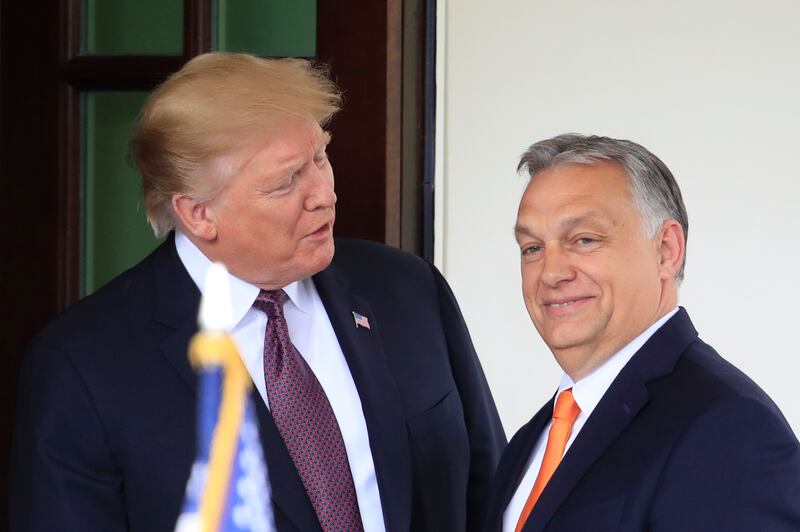
Orban has also heaped praise on Trump and was one of the first leaders to back the US president’s “Board of Peace”, ostensibly aimed at resolving world conflicts. Most European countries, including Ireland, have not signed up the board, whose charter states that Trump will be chairman for life. Orban, meanwhile, is due to attend the board’s first meeting in Washington next week where he is scheduled to meet Trump.
Political observers are sceptical that US intervention will provide Orban with an electoral boost.
Peter Kreko, an analyst and head of the Politcal Capital think tank in Budapest, says Trump’s popularity is largely limited to Orban loyalists. “As in almost every country, Hungarians typically vote more on domestic issues, not international policy issues,” he told the Times.
Tom Mortimer also says cost-of-living issues will dominate the thoughts of most Hungarians when they go the polls in April.
“People, obviously, ultimately vote because of what’s in their wallet and that has decreased significantly in the past few years, especially since the Ukraine war,” he says.
“Ultimately, when you see the amount of money being spent on stadiums and on sporting infrastructure compared to what is being spent on public infrastructure and bringing the cost of a daily shop down, that eventually does start to have an effect on people.”
In the summer of 2025, Hungary was ranked the poorest nation in the European Union in terms of household consumption, stagnating at 72 per cent of the EU average.
After more than 15 years in power, Mortimer says some voters are tiring of what they see as political cronyism and want change.
“I think sometimes in society you can overlook [this] only for so long as long as you are getting other successes elsewhere,” he says. “I wonder if the symbol of the failure of what we saw on the pitch against Ireland maybe is just something that may have an effect on the election coming up in April.”