If nothing else, the sheer scale of Ireland’s wounding 36-14 loss to France on the opening night of the Six Nations means the coming week will be very interesting. The management and squad need to come up with a big reaction. As such, next Thursday’s announcement of the team to face Italy two days later at the Aviva Stadium takes on added significance.
Coupled with last Friday night’s Ireland XV game, the Italians’ meeting with Scotland in the Stadio Olimpico on Saturday and, most of all, the dissection of Thursday night’s defeat in the Stade de France, Andy Farrell and his staff have much to ponder over the weekend before reassembling on Sunday night.
There will be evidence for changes, but there will also be a strong inclination to afford most of the team that pitched up in Paris another chance.
“Yeah, it’s obviously at the forefront of our mind, selection, and how we get the best response from that,” said Farrell in the aftermath of the defeat. “Sometimes, it’s giving people another chance, but we have to look at the in-depth reality of how it went and act accordingly to that.”
READ MORE


These conflicting feelings are compounded by the impact of the bench after a quadruple substitution by the 50th minute when the visitors were 29-0 down.
The Irish head coach could not disguise his displeasure with his players’ “lack of intent”, although he maintained this was not as disconcerting as it seemed.
“It doesn’t worry me because I know the people that we’ve got, but it’s the reality of what happened. It’s hard for me to say it because I actually thought they showed up in the second half with a bit of intention. We could have been better as far as our execution of stuff, but at least we had the right intention.”
But then, in the same breath, he added: “It’s too late or too easy to have that when it was so lacking in the first half.”
Even when it was put to him that his replacements had galvanised the rest of the team, he agreed to a point. “Yeah, and fair play to them. Nothing to lose and all that. But we’re a team and we have to be better than that.”
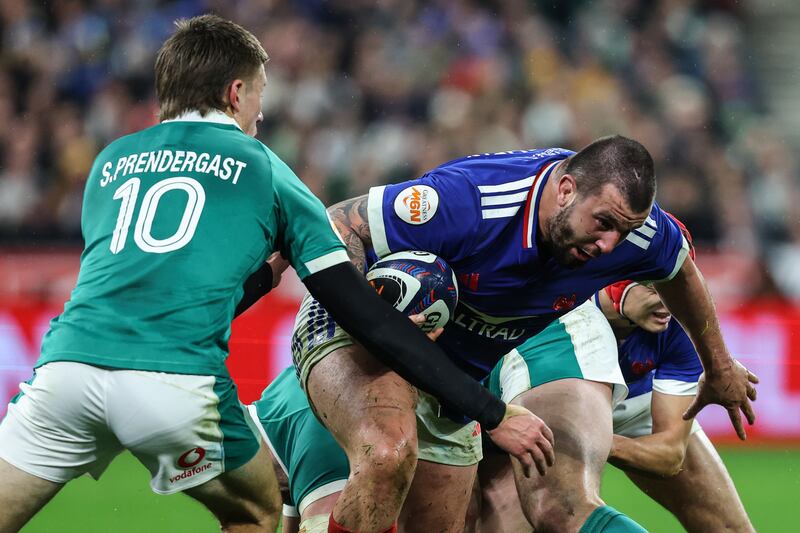
Perhaps nowhere is the stick-or-twist gamble more evident than at outhalf where Sam Prendergast had, well, a very Sam Prendergast kind of game. His critics will cite the seven missed tackles, while his supporters will point to some of the inventive things he did, such as the perfect kick-pass to Tommy O’Brien in the first half and the delayed short pass to Stuart McCloskey for his try-scoring offload to Nick Timoney.
There was plenty of stuff in between too, but Josh van der Flier’s failure to hold on to his offload was not down to Prendergast. The same goes for Tadhg Beirne’s struggle with a short pass. Prendergast did seem a little rattled in the first half and the backline attack was sometimes quite lateral.
How far behind the leading pack are Ireland after defeat against France?
“It’s tough, isn’t it, for a flyhalf when you’re on the back foot,” said Farrell sympathetically. “It’s tough to judge him in that regard but another experience under his belt to stand to him.”
Nor did Farrell believe that the introduction of a second playmaker in Jack Crowley dramatically improved the Irish attack.
“I disagree with that. It’s through intention, that’s the go-forward. That’s why that was happening. Jamie [Osborne] is a second playmaker as well but we never really got into those positions because of all that.”
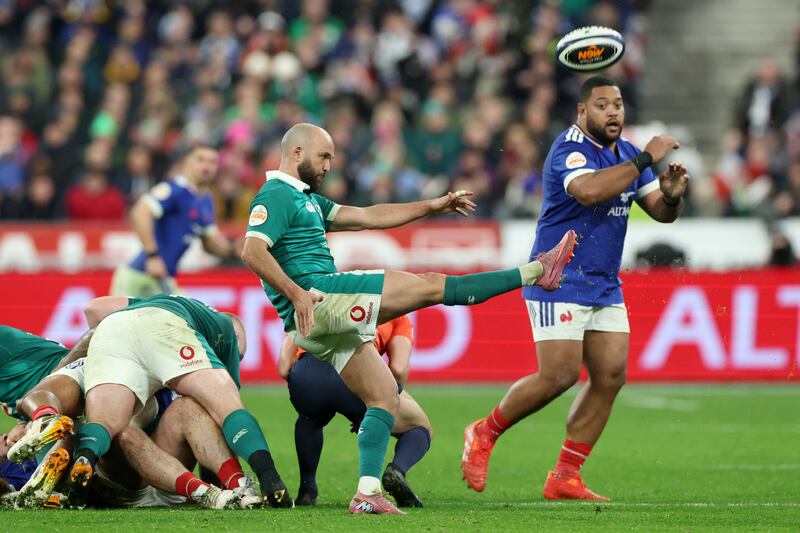
Farrell did not think Ireland overplayed their kicking game when resorting to a bombardment of Jamison Gibson-Park box kicks, which were mostly on the money but rarely reclaimed. The tactic was reverted to after scoring two tries.
“No; you saw the conditions,” said the head coach. ”They did exactly the same. You could always judge whether [it was the right decision] after the event, whether we did or we didn’t. It’s not just about the kick, it’s about the quality of the execution of the whole thing, isn’t it? And, yeah, they certainly won that battle.”
When asked about the causes of the alarming defensive deficiencies, Farrell said: “It was almost as though we were ready for them to play wet-weather rugby . . . You earn the right to offload and that’s because you’re winning collisions. The way that they were playing, we were allowing them to do that because of that.
“They earned the right, through the contact. It’s not as though they were throwing risky offloads or 50-50s or whatever. They’d earned the right to do that and the pace they’ve got to finish that off is there for everyone to see.”
There were other positives in the efficiency of Ireland’s lineout and scrum, with Farrell saying: “I thought Jeremy Loughman did himself proud."
But the forthcoming Italian week now looks more challenging.
“I think it was going to be challenging anyway,” said the head coach. “I think they’re a good team. Italy are not the Italy of old. I think we all realise that. We know that we need to be on point to beat them. But there has to be a response to this, otherwise it’s for nothing.”
At least Ireland’s injury list wasn’t lengthened and they have a nine-day turnaround before facing Italy. He added: “Wounded pride, bangs and bruises. That’s one thing about the two-day-short preparation [this week]; might stand to us next week.”