

Sitting in a room within a stone’s throw of the Houses of Parliament at Westminster, the conversation lingers over the echoes of shots fired 34 years ago.
They were fired shortly before 11pm on a dark night in February 1992 outside St Patrick’s Church in Clonoe, Co Tyrone, during the Troubles.
Three men sit now around a table in central London for a difficult conversation with The Irish Times about the past.
Each was a member of the British army’s elite special-forces unit, the Special Air Service (SAS), known as “the regiment” to its own. Each is a veteran of dozens of operations in the North.
READ MORE


Quietly, and sometimes not so quietly, the three men express fury at last February’s decision by Judge Michael Humphreys, Northern Ireland’s presiding coroner, who is responsible for legacy litigation, to refer the Clonoe shootings of four IRA men by the SAS to the Director of Public Prosecutions
Kevin Barry O’Donnell (21), Patrick Vincent (20), Peter Clancy (21) and Sean O’Farrell (22) hijacked a truck in Coalisland, Co Tyrone, and welded a mount on to it for a heavy machine-gun.
The high-calibre Russian-made gun could slice open 20mm of armour at 500m, destroy trucks and armoured cars, and cause “absolute and catastrophic” injuries to humans, as one weapons manual puts it.
Having shot up the RUC station in Coalisland, without causing injury, the IRA men went to St Patrick’s Church where their unit was to break up.
Instead, they met an SAS team hidden in hedges from before 8pm that evening. Over several minutes, more than 500 rounds were fired.
Conflicting accounts of what happened that night have arisen.
Humphreys ruled that the soldiers had not challenged the IRA men to surrender, that no shots had been fired at them, and that they did not have “an honest belief” that lethal force was necessary.
“The use of lethal force was not justified at Clonoe,” he said, ruling that “not all of the pertinent facts were known” by those who planned the SAS operation in the days before the shootings.
The charge that the IRA men had opened fire “was demonstrably untrue and must have been known to be untrue”. Statements made by the SAS to the RUC were filled with “false justifications”, and poorly challenged by the police, the judge said.
Making little effort to hide his contempt, George “Geordie” Simm, who served from 1975 to 1999 in the SAS, with multiple tours in Northern Ireland, rejects Humphreys’s ruling, line by line.
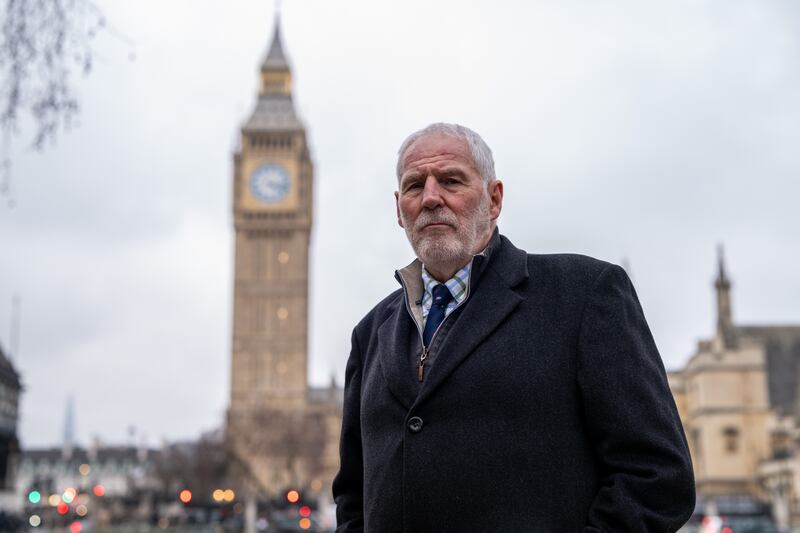
Soldiers covered only by hedges could not call on IRA men to surrender when they were armed with a heavy machine-gun that could destroy them in seconds without risking their own lives, he argues.
One IRA member, Aidan McKeever, was given first aid by a soldier as he lay slumped in a Vauxhall Cavalier.
“Is that consistent with the narrative that it was shoot-to-kill? It’s nonsense,” Simm tells The Irish Times.
Throughout the Troubles, the SAS faced allegations that it was key to the operation of a British Government-ordered “shoot-to-kill” policy, from Loughgall, Co Armagh in 1987 when the SAS killed an eight-man IRA team, to Coagh, Co Tyrone in 1991 when the SAS killed three IRA men, to Clonoe along with earlier controversial killings.
“It’s a mantra; it’s a slogan,” says Simm, a retired regimental sergeant major who argues that the past is now being “weaponised by Sinn Féin” to win the history of the Troubles.
One of his former colleagues around the table, a former SAS lieutenant colonel who cannot be identified for security reasons, led SAS units during the Troubles and previously ran close-quarter observation operations in “dykes, drains and ruined buildings for thousands of hours” in south Armagh and elsewhere.
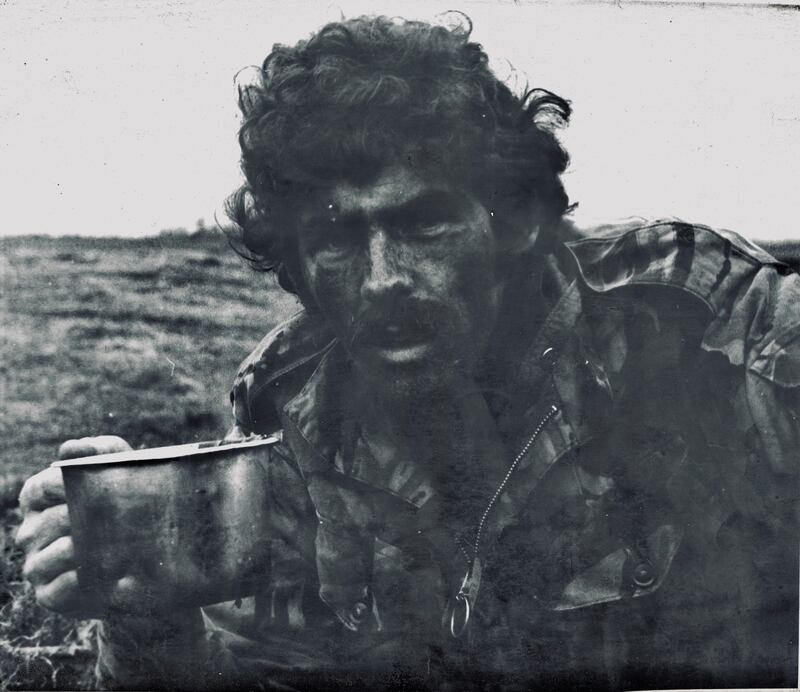
“Some compatriots of yours will, I’m sure, regard us as a kind of antichrist and will see us as a kind of murderous undertaking, but the statistics simply don’t back it up,” he says.
“From the mid-80s to the mid-90s, we arrested about 75 terrorists, of which 14 were injured, and we killed, I think, 35. Even the raw statistics show that we arrested many more than we killed.”
The briefings given to the SAS before operations were based on intelligence – sometimes partial, sometimes incomplete – provided by the Royal Ulster Constabulary or other elements of the British army.
[ From the archive: Michelle O’Neill defends attendance at Loughgall commemorationOpens in new window ]
Challenged, he is asked about the oft-repeated story of the former RUC chief constable Jack Hermon once saying, privately, that he always knew he “would not be counting prisoners” after authorising an SAS operation.
The former officer bridles, rejecting the story.
“If there had been a shoot-to-kill policy in Northern Ireland, then I think as the commander of an SAS unit, somebody might have told me about it,” he says.
“I can honestly say no one ever mentioned anything like it; indeed, quite the contrary. We put huge efforts into making sure that everything we did was legally watertight. The idea that we played hard and fast with the law was nonsense, is nonsense.”
Humphreys’s judgment has significant implications, he says, even though the coroner “has no military experience, has never heard a shot fired in anger” and “seems to have no memory of the Troubles”.
Some of his judgment displayed “extremely naive assumptions”, says the retired officer.
The judge’s reference to the significance of the safety catches being on the IRA weapons prompts derisive laughter.
“It’s pitch dark, and things are happening quickly,” says the former lieutenant colonel.
Even the ruling that the IRA did not fire is not accepted. One soldier, Soldier H, was hit in the face, but the judge decided that was from a ricocheted round fired by his own side.
“Armour-piercing rounds don’t ricochet,” Simm argues.
Clonoe and incidents like it are central to the growing anger of serving and retired British veterans, who argue that the British government’s legacy legislation leaves soldiers open to repeated legal assault.
And it not just a battle about the past. It is about the future of the British army, they argue.
In a letter to The Times newspaper last November, nine four-star British generals warned the legislation risked “weakening the moral foundations and operational effectiveness” of the British military.
“It is presented as a route to justice and closure; the bill achieves neither. It will not bring terrorists to account; it will not heal division in Northern Ireland,” they said.
They warned that hundreds of Troubles-related legal cases pose “a direct threat to national security”.
Former commander of the SAS Colonel Richard Williams, who led the regiment between 2005 and 2008, and who served in Northern Ireland during the 1990s, strongly agrees.
“To be absolutely clear, the degree of control, care, consideration and precision in Ireland has not been matched since,” says Williams, who later served in Afghanistan, Iraq and elsewhere.
During hours of conversation with the former SAS members, anger at the Northern Ireland Secretary of State, Hilary Benn, emerges.
They are particularly angered at his pledge to hold an inquest into the Loughgall killings of eight members of the IRA’s East Tyrone Brigade in 1987.
For the former SAS men in the room, the decision is baffling. Men such as Jim Lynagh and Paddy Kelly had killed many times before and would have done so again; they had come heavily armed to bomb and strafe Loughgall’s RUC station.

An inquest was ordered by Northern Ireland’s Advocate General in 2015, but a judge later ruled that it could not begin before the guillotine imposed by the Conservative government to end Troubles-related legal cases fell in 2023.
For years, Loughgall has been surrounded by conspiracy theories: that one of the eight had been an informer, but was killed anyway; or that the deaths of men from that active brigade were useful as the IRA’s leaders turned slowly to politics.
Rejecting these claims, Simm says the soldiers had been deployed five or six times before to stop an IRA attack on a rural RUC station.
“They thought it was going to be another such day. Then – boom – the side of the building went in from a 400lb bomb,” he says.
So what were the SAS supposed to do, asks the retired lieutenant colonel? How would they try to arrest heavily armed IRA men equipped with a bomb, he asks; if they would not be arrested, they would have to be fired upon, he argues.
Doing nothing was not an option because intelligence – partial, as they insist it was – might not have been as good the next time the IRA attacked a rural RUC station, with policemen unable to defend themselves.
“You have to play the cards you’re given. If I intervene now, how many lives do I save by taking out these terrorists – ideally, by arresting them? That is the constant problem that people who run these sorts of operations faced, and face now,” he says.
If I had been told that under no circumstances is anyone to be killed, then I would not deploy. I would not deploy my men. You might as well send soldiers in unarmed
— Former SAS lieutenant colonel
“What’s the balance between intervening now to save lives, or not intervening, but at the risk that the same attack, or a similar one will happen at some other time, at some other place,” the lieutenant colonel says.
The former SAS members are asked, do the arrests of IRA members Michael Caraher and Bernard McGinn in a haybarn in Cregganduff, south Armagh in April 1997 not show that IRA members could be arrested and not killed?.
For years, it has been argued – even accepted by senior British figures in private conversations with this reporter – that the SAS were told that the two could “under no circumstances” be killed because that would scupper the then deadlocked Stormont peace talks.
A chorus of disagreement follows.
“Nonsense,” says Simm.
Yes, they accept such claims have been made but not by anyone who knew anything about running an SAS operation in the IRA’s heartland in south Armagh.
His former lieutenant colonel agrees.
“If I had been told that under no circumstances is anyone to be killed, then I would not deploy. I would not deploy my men. You might as well send soldiers in unarmed,” he says.
An SAS-RUC operation in dangerous territory was conducted quickly, with complete surprise, the regiment argues. The two IRA men were captured near to but not holding weapons, including a M50 Barrett sniper rifle, and a Russian-made AKM machine-gun.
“Somebody in Number 10 [Downing Street] may well have said what you said, but that doesn’t mean to say that’s what happened – or could have happened, actually,” the former officer says.
But do they accept that British soldiers should have faced prosecution for wrongful acts during the Troubles?
The former SAS members accept this but not that the SAS committed such acts, arguing that they followed lawful orders to the letter.
“Of course, the British army made mistakes; there’s no question about that. Generally, it’s because it was young fellows, who were overtaken by events, or whatever,” says Simm, a north of England native and the son of a Fermanagh man who left Northern Ireland.
“When you talk about us – it’s the diametric opposite. These guys are your thinking-man’s soldier. There’s quite a number from the Republic who serve today actually and many did so in the past,” he says.
A succession of cases involving killings at the hands of British soldiers during the Troubles are raised with the former SAS members.
They include Dennis Hutchings, who died aged 80 in 2021 while on trial for attempted murder over the 1974 killing of a 27-year-old John Pat Cunningham in Co Tyrone who was shot in the back as he ran away.
Even his commanding officer accepted that Hutchings, described as “a warfighting soldier”, was not a soldier who should ever have been sent to Northern Ireland.
The former SAS men do not disagree.
“Nobody could possibly sit here and say that nothing went wrong on any one of the thousands and thousands of patrols, contacts, incidents, that there wasn’t a single episode when a soldier acted outside the law,” says the anonymous officer.
[Soldier F] can only be viewed as a show trial. It had no prospect of conviction. Rightly the guy was not convicted – whatever the rights and wrongs of what he may, or may not have done
— Former SAS officer
“Nobody could say that. There’s bound to have been. But the operations we ran were high-end operations where we took such care to make sure that everything was as carefully managed as we could,” he adds.
“With hand on heart, I am not aware of and I would be astonished if there was a single episode where an SAS soldier acted outside the law. I would be astonished because we put so much effort in.”
The conversation with the former SAS officers turns to Soldier F, who was last October acquitted of two killings in Derry on Bloody Sunday in January 1972. The Saville Inquiry found in 2012 that Soldier F had killed two unarmed men, Paddy Doherty and Bernard McGuigan.
Saville found, too, that Soldier F likely killed two more, William McKinney and James Wray, and the judge rejected his claims that 17-year old Michael Kelly, whom he admitted shooting, had been armed.
Rejecting none of the inquiry’s conclusions, the former SAS men still do not believe that Soldier F – a member of the British Parachute Regiment, not the SAS, should have been prosecuted in 2025, whatever about a potential prosecution soon after Bloody Sunday.

Saville did not operate to criminal prosecution standards, they point out.
“It’s clear to a six-year-old that there wasn’t enough evidence to convict him 50-something years on, based entirely on hearsay from two soldiers, one of whom’s dead,” says the former lieutenant colonel.
“That can only be viewed as a show trial. It had no prospect of conviction. Rightly the guy was not convicted – whatever the rights and wrongs of what he may, or may not have done.
“There was zero prospect of conviction. So why was he put on trial? It can only have been for the purposes of PR, for the purposes of appeasing one political party, or other.”
They accept few military prosecutions have happened, but hundreds of veterans now credibly fear they could be drawn into civil cases, inquests and other legal proceedings under the legacy legislation.
“Dozens and dozens of soldiers are stuck in a Kafkaesque maelstrom of legal process which is essentially open ended. They’re looking at years and years and years of legal action,” says the former lieutenant colonel.
“Whether that’s inquests, or whether it’s private civil actions. The likelihood of anyone being prosecuted for serious crimes is really quite small for the same reason that there’s no evidence.
“However, the likelihood of them being involved for potentially up to decades in civil actions and inquests is really very high.”
The other former SAS members nod in agreement.
Last November, the SAS Regimental Association, which represents current and former SAS members, warned Benn, the Northern Ireland Secretary, that it would go to court unless the legislation is changed to protect veterans adequately.
In the face of this legal threat, the UK government responded.
“We started getting calls. It had the effect of making government sit up and pay attention. Prior to that, there was a lot of ‘yeah, yeah, whatever’,” says the anonymous officer.
“They ought to be concerned when five former chiefs of the defence staff and nine former four-stars write in very clear, cogent terms about what this means. They really should be paying attention.”
So what do they believe should happen?
Families of those killed, including by the IRA and others, should receive as much information as possible from the Independent Commission on Reconciliation and Information Recovery or by other means, they argue.
Equally, the Irish Government should open its own books. Dublin forced London to toughen the legacy legislation, yet consistently refuses to deal with its own Troubles sins, including information the gardaí had in advance of the Omagh bombing, says Simm.
The Irish Government stopped prosecuting Troubles-related cases after the 1998 Belfast Agreement, yet it has demanded that the British Government prosecutes its own, he argues.
“It’s an immoral position to take. It’s wrong on so many levels,” says Simm.
With nods of agreement from his former colleagues, he continues: “[Dublin] always had an ambivalent attitude towards armed republicanism. For understandable political reasons, the British government doesn’t seem to want to call it out on that.
“I understand why, obviously. But all of that adds to this distorting tension in the picture we’re talking about here,” says Simm.

For Richard Williams, the battle over legacy is not just about the past, but will determine the future of the British Army, though he believes its leaders made major mistakes nearly 30 years ago.
The British army should have sought exemptions when Tony Blair’s government passed the Human Rights Act in 1998, bringing the military under Article 2 obligations to protect the right to life, he says.
“What is an Article 2-compliant operation? Where the enemy combatant you’re going against is quite evidently an enemy combatant because he’s trying to kill you. Where does Article 2 apply then?” Williams asks.
In reality, the British military adopted the Human Rights Act without considering the use of force in combat.
“The question that people like me ask, being blunt, is have they outlawed war?” asks Williams.
The British army went to Iraq with habits from Northern Ireland that rapidly proved unworkable in a far tougher conflict.
“Good intentions, when taken to the extreme, deny forces the ability to operate,” says Williams.
“Things had to change to allow operations to be conducted, not just special operations, but conventional operations, in ways that protected the life of our soldiers within the bounds of what was reasonable.”


