
The cost of heating and lighting homes and powering businesses on both sides of the Border can differ by hundreds of euro annually, according to some price comparisons, amid fresh claims that consumers in the Republic are being ripped off.
Daragh Cassidy of price comparison and switching website Bonkers.ie says quantifying cross-Border cost differences is tricky. But “in general”, he says, electricity prices in Northern Ireland are about 10 to 15 per cent lower than in the Republic .
“For gas, it’s even bigger. Prices in Northern Ireland can be over 20 per cent cheaper in many cases.”
He was speaking in the wake of a recent report by the Nevin Economic Research Institute (Neri) showing Irish electricity prices have “risen substantially” since the mid-1990s, with their growth “dramatic” compared to other EU states.
READ MORE


As of September 2025, Neri put the price of electricity at more than four times its January 1996 level, only slightly in advance of the increase – 3.88 times – in the UK over the same time period, and higher than any other state in the EU, where it was the only one which “exceeded increases of 200 per cent”.
[ Want to see an end to high electricity prices? This is what we need to doOpens in new window ]
Sinn Féin has accused electricity companies of “price gouging” and “fleecing” Irish households in the wake of Neri’s findings. Its spokesman on energy, Pa Daly, called for action from the Government and the State’s Commission for Regulation of Utilities (CRU), saying they must tackle this “head on”.
Direct comparisons between prices North and South come with caveats, however. Edward Doherty, who runs businesses on both sides of the Border, can testify to that.
“Margins are so tight, especially when you’re making your own stuff, but what we always do is try to make a home from home – a cafe that is comfortable and warm and you could just sit and chat for an hour over coffee,” he says.
In Tank and Skinny’s cafe in Muff, Co Donegal, there’s indeed no shortage of people sitting chatting.

The cafe, which opened in 2016, was the first of what has become a chain of five owned by Edward and his brother Shane. There are three in Donegal, one in Sligo and one over the Border in Limavady, Co Derry.
The decision to expand into the North “wasn’t ‘let’s go into the North’; it was that we know the road from the Foyle Bridge [in Derry] to Coleraine quite well, and yes there were petrol stations and grab-and-go coffees and whatever, but there was no sit-down coffee shop”, explains Doherty.

“The North comes with its own challenges. Wages, in the North they’ve gone up a lot more, and I’d say the minimum wage in the North would now be slightly higher. There’s VAT rates. The VAT rate is 20 per cent; in the South it’s 13 and a half, soon to be 9 per cent, so that’s 20p out of every pound gone. It’s a big chunk before you even take in anything else.
“Even the National Insurance in comparison to PRSI is 15 per cent to 11 per cent,” he says. “It’s [Northern Ireland is] a great place to do business, but when you break it down, it’s just that bit more difficult.”
Strewn on the table in front of him are electricity bills. To try to make a comparison, he focuses on only two cafes, one on either side of the Border.
“It’s hard to even give a price per unit, because there are so many other variables – there’s electricity tax, there’s levy flat charges, supply and capacity charges,” says Doherty.
He reads out the figures.
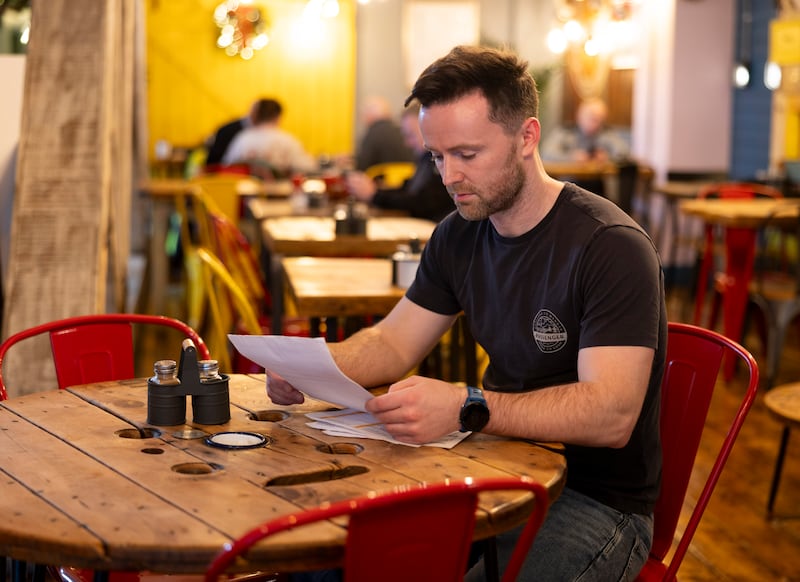
September’s electricity bill in Limavady was £1,536 (€1,780), compared with €1,888 (£1,629) in Muff; in October, Limavady’s electricity cost £1,785 (€2,069) and Muff was €2,059 (£1,776). With the caveat that it is only a rough estimate – and the Muff premises is “twice the size of Limavady” – when the currency exchange is taken into account, Doherty concludes “it’s much of a muchness” on either side of the Border.
Cassidy agrees that direct price comparisons are tricky.
“As in any market, the price you pay for energy in Northern Ireland will depend on several factors such as your supplier, your region, the type of plan you’re on, whether you’ve switched to an introductory discounted tariff and whether you pay by direct debit or not,” he says. “And if you’re on a smart electricity tariff, the price will also depend on when you use your energy.”
‘The Irish grid is also undergoing a period of huge investment, meaning grid fees have increased a lot over the last few years. And these ultimately get passed on to consumers’
— Daragh Cassidy, Bonkers.ie
Cassidy points out that VAT on energy bills is charged at 5 per cent in the North compared to 9 per cent in the Republic.
While the minimum wage may have gone up in Northern Ireland, Cassidy says, “Wages and the general cost of living in the North are also lower than here [in the Republic], so this would have a small impact too. The Irish grid is also undergoing a period of huge investment, meaning grid fees have increased a lot over the last few years. And these ultimately get passed on to consumers.”
He adds that the prices for large, industrial users, mean the difference is lower. “And in some cases commercial rates are lower in the Republic than in Northern Ireland. So it could be a case that households are subsidising larger users to a certain degree.”
He points out that the market south of the Border “is also a fully liberalised market where suppliers are pretty much free to set their own prices for electricity and gas. However, the Northern Ireland market is more heavily regulated. The bigger suppliers are price-controlled and have to seek the approval of the regulator to increase prices, which will take into account their level of profit before sanctioning any price change”.
Figures compiled by Northern Ireland’s Utility Regulator are also inconclusive. Its price comparisons have fluctuated over time, with Southern prices sometimes emerging as more expensive.
According to the regulator’s most recent quarterly market monitoring report, published in December, and based on the consumption of medium-sized domestic customers – with all prices converted to pence sterling for ease of comparison – from January to June 2025, domestic electricity prices in the North were 30.6 p/kWh, higher than the Republic of Ireland (27.5 p/kWh), the UK (29.7 p/kWh) and the EU median (22.4 p/kWh).
Regarding price differences between North and South, “it is really hard to calculate”, says Niall Farrell, associate research professor at the Economic and Social Research Institute (ESRI). “There is a difference, but it’s not a huge difference.”
He says this is not unexpected. The island of Ireland is a single wholesale market for electricity, so “it all comes from the same place… any difference will be on the supply side” and prices “should be quite similar”.
However, what can be said with confidence is that electricity prices in Ireland, North and South, “are much greater than the EU median”.
There are a number of explanations for this, not least the price of generating electricity, which in Ireland is affected by high gas prices.
“The cost of generation has fallen in recent years but it’s still higher than it used to be, so why hasn’t that been passed through, maybe to the extent it has been in other countries?” asks Farrell.
“Potential explanations could be [that] it’s a small market; maybe it’s less competitive than in other countries; maybe it means it’s riskier for suppliers, so they have to build an extra buffer,” he says. “Or maybe there’s another explanation we don’t know about yet.
“It could be a job for the regulator to investigate that and see what exactly is driving that. If it’s an issue of competition, then that’s something the regulator might need to investigate and be involved in.”
The construction of the long-delayed North South Interconnector and, ultimately, moving away from the reliance on gas to generate electricity would, in the long term, reduce the cost of electricity in Ireland.
“If we have more renewables plus the interconnector, then we could make better use of those renewables. That would have a compounding effect, so it would be win-win all round,” says Farrell.


