“I’m the most Irish person you will meet with an English accent,” says London-born entrepreneur Jacqueline O’Donovan.
People who grow up in Ireland are lucky because “no matter where they are from, you can hear the accent”, the OBE recipient says.
Speaking as she traverses London early one morning, what comes across more than her distinctive accent is how closely she holds her west Cork roots and a “dual sense of belonging”.
O’Donovan’s parents both moved to the UK in the 1950s from the village of Goleen before settling in the London suburb of Kilburn, “the 33rd county” and raising four children. However, her father Joe’s death in 1985, aged 51, propelled her from a planned career in childcare into the family waste management business at 19.
READ MORE


“Thrown in at the deep end” as managing director, O’Donovan had to “think or swim ... I felt female in a male dominated world but it bothered men more than me”. She left school at 16, went back to study at night to qualify in transport management.
She became determined to change the perception of the “cowboy industry” and in 2023 received the OBE for her “outstanding contribution to recycling, safety, and industry”.
Along with her siblings, she grew O’Donovan Waste Disposal into a firm with revenues of more than €20 million before it was sold to a Swedish conglomerate in 2023.
Her family’s humble roots are at the heart of this success story, “having that grounding, to come from a one-bed flat in Kilburn to The Dorchester last February to celebrate my OBE from King Charles”.
After her father moved to England with a “gang of fellas” in the 1950s, he eventually sent enough money to her mother, then working in the family shop in Skibbereen, to join him.
He worked for British Rail and in demolition before going into waste. “He was phenomenally successful,” she says.
“When I think about what they came from, two-ups and two-down, no bathroom,” she says. She recalls her father putting the first fluorescent light in his parents’ home, and they were “looking at it as if it were an alien”.
“To think they came from that, and what they have created, it is phenomenal”.
O’Donovan pauses. “My parents were lucky they made it”.
She notes how many Irish emigrants from this time don’t talk much about the old days.
“My mum doesn’t say much about it, it’s an era they don’t really want to talk about ... Every now and then you get a snippet.” She says her mother (90) recently told her how “she snuck out of a window the size of a drawer to leave on a boat to go to Dad”.
The family would return to west Cork for every childhood holiday, and it was the “most poignant place” for her growing up, she says. “Before her dad really made it”, the six of them would stay in a one-bed caravan for their summer holidays. Often, the family would bring an extra passenger, another returning emigrant, on the journey home, “crammed” in the car to the ferry. O’Donovan recalls being “shoved in the footwell covered blanket” to avoid paying a fare during more difficult financial times.
Recalling the diversity of Irish emigrants she encountered in childhood, O’Donovan gives the sense that their stories have left their mark on her. She is deeply involved in supporting the Irish community in London, and was recognised for this by Michael D Higgins, receiving the Presidential Distinguished Service Awards for the Irish Abroad in 2017.
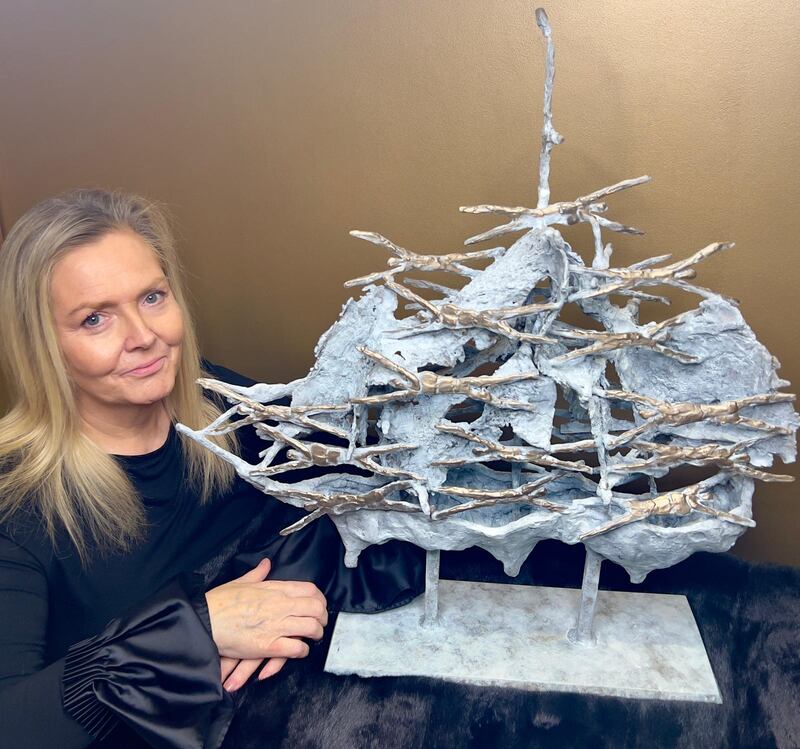
One of her most prized possessions is a famine ship sculpture by John Behan. “When I look at it, I just think about what they suffered to make a better life for us, which should never be forgotten”
While O’Donovan carries “Ireland in her heart”, being second-generation Irish isn’t always straightforward.
“If I’m in Ireland and I say I am Irish people will look at me strangely. And in England, people will say, ‘you don’t sound it’,” she says. “My son has a ginger beard, so he laughs, points at the beard and says ‘that gives it away’.”
Of the reaction she receives from Irish people, she says: “I’m not letting anyone with an Irish accent and born in Ireland tell me I’m not Irish. Just because you are born in a stable does not make you a horse.”
She notes the enormous shift there has been in Irish identity in the UK, with the new generation of Irish in London working as accountants, lawyers and financial advisers rather than in construction.
The perception of being Irish has done a complete “360”, whereas during the Troubles, you had to be careful what you said; now people are “shouting about where they are from”.
O’Donovan’s voice sounds calmer when she speaks of west Cork, where she has a house. It’s her “happy place”.
“It’s the freedom, the fresh air, I just feel connected with it,” she says wistfully as the traffic noise of London sounds in the background.
- Are you Irish and living in another country? Would you like to share your experience in writing or by interview? You can use the form below, or email abroad@irishtimes.com. Irish Times Abroad submission guidelines here.
- Follow us on Instagram to keep up with the latest
- Sign up to The Irish Times Abroad newsletter for Irish-connected people around the world.