When I was 18 and in my first year at Trinity College, I moved out of home and into a house-share in Ranelagh, just south of Dublin’s city centre. My father drove me in, the rear seats of our old Renault 18 estate car folded down to allow for several bin-liners full of clothes, a crate or two of books and a bottle-green 1950s Raleigh bicycle.
This last had once belonged to my mother and now belonged to me, the first bike I had ever owned. Growing up, there was no need for bicycles, or rather, no use case. Our house stood on the side of a steep and winding hill. Cycling down to Bray, 5km away, was a terrifying blast, the return an exhausting slog.
Nevertheless, it was a beautiful place to grow up, with a view so stunning that on sunny days even the postman stepped out of his van for a look. Adolescence had dulled that beauty. I yearned for concrete and for city streets strung with strangers like a necklace of beads; now, finally, with this move into Dublin, I was going to get them.
After my dad schlepped my boxes up the narrow stairs, slipped me a 20 pound note and drove away, I sat on my new bed looking out the window at the roofs beyond. In each of those houses, people I didn’t know – Dubliners – were living their lives. Each terraced street connected to another, so if you went down one, and kept going, you’d eventually arrive at St Stephen’s Green or the river Liffey or Parnell Square.
READ MORE


These placenames held for me a charge quite unlike the inert placenames of suburbia. At that time, I was in the habit of taking the Dart into Dublin every Saturday to cruise for vintage Levi 501s in Temple Bar, to puzzle over the art in the Douglas Hyde Gallery, to drink tea in the Well Fed Café, a frankly terrifying workers’ co-op run by punks and feminists.
Although I was otherwise sociable, I took those Saturday trips alone, not sure enough of my intentions to sell the idea to anyone else. I wanted the freedom to stop and stare, to drift down alleys, to loiter in the vicinity of strangers who intrigued me. Dublin was a shabby, half-broken city in the 1980s, a place of hoardings and weeds, but I loved it with a passion I couldn’t explain and I wanted a version of it that belonged to me.
The quickest way to go about this would have been to talk to people, but I was 16 years old and still swaddled in awkwardness. Instead, I set myself the project of absorbing the city by osmosis, walking for hours at a stretch. It seemed fair to me, as I mooched around in my second-hand suede jacket and knock-off Doc Martens, that my status in the city was that of a tourist, a fan, a groupie. I knew that at the end of the day, as shutters rattled down over shop windows, and the flower sellers on Grafton Street emptied buckets of dirty water into the gutter, I would be sitting on the Dart back to Bray.
In those final moments, I was keenly aware that the city was coming to life as I left; the buskers scooping coins into their pockets and heading to the Coffee Inn for a plate of spaghetti, the pavement outside Kehoe’s pub accumulating drinkers. Dublin would carry on without me, had not even noticed I was there, and although, at 16, I took everything personally, I did not take this personally. Dublin was a movie star. I might as well take offence at a sunset.
All that changed on the Sunday afternoon I became a Dubliner myself. When my father drove off, I had a sudden new sense of the city’s permeability. I was only renting my room by the month, but now that I possessed a front-door key, Dublin belonged to me just as much as anyone else. I decided to take my mother’s old Raleigh out for a spin, cycling through the darkening city with no destination in mind.


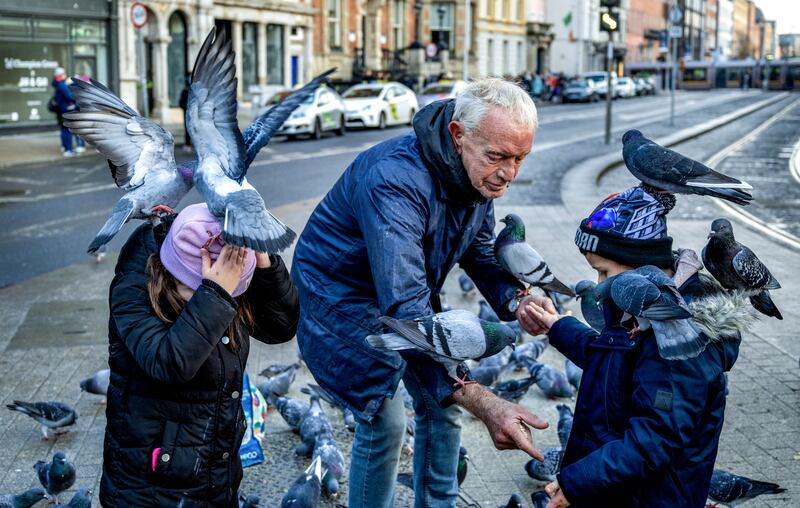
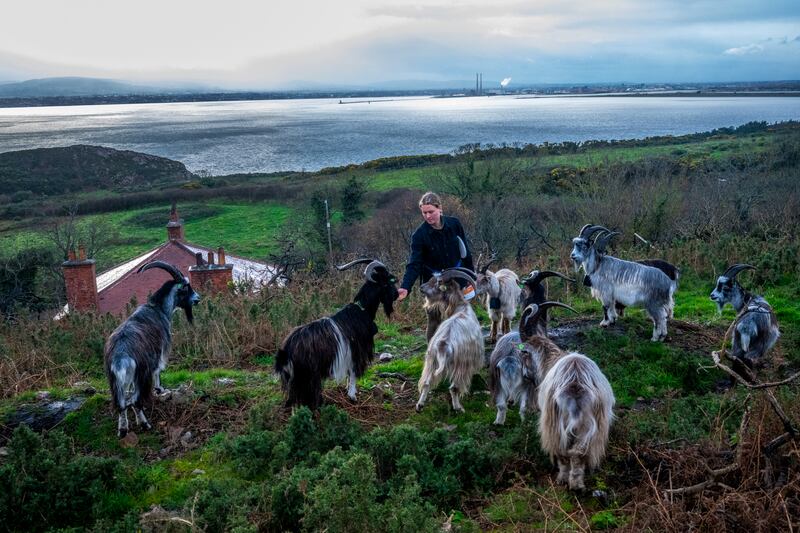
Lights were coming on in some of the high Georgian town houses, the arched fanlights over the doors glowing like half slices of lemon. It was Sunday evening, the shops were closed and the city was bathed in that peculiar Sunday stillness which was as much a state of mind as a day of the week. I cycled for what felt like hours, turning left or right at a whim, getting lost and un-lost.
A lucky final pass brought me up Winetavern Street to Leo Burdock’s fish and chip shop, and I joined the shuffling queue. When my turn came, I placed the same order as the woman in front of me and ate it sitting on a wall outside, just one more Dubliner, devouring smoked cod and chips on a Sunday. A feeling like a bright balloon inflated in my chest, not indigestion but love. I could not believe I was allowed to live in this city. I knew I would never leave.


Some 30-odd years on from that dreamy cycle, I am sitting in a window seat on a Ryanair flight, watching Dublin take shape beyond the Plexiglas window. These days, it’s Berlin I cycle round on a daily basis while Dublin is the place I visit. Although I left willingly, and return frequently, I’m always a little mournful on the approach over the Irish Sea, filled with the old love for the place, incredulous I ever left.
This time, though, I’m full of a strange apprehension, a giddiness. The Little Museum of Dublin has commissioned me to write about the city, an essay to accompany beautiful photos by Pulitzer-winning photographer Deanne Fitzmaurice. It’s a dream commission, but also, a daunting one. How to do justice to a city so various, so old, so storied? I once knew Dublin inside out, not least because I wrote about it for this paper for many years, but cities are not known for standing still.
Buildings may stay the same, or not; people certainly don’t, and a new generation of Dubliners owns the city now. On the other hand, familiarity with a city can result in a kind of blindness. You see what you expect to see, and you don’t always know what you don’t know.
In the days that follow, and on future research trips, I walk the city for hours at a time, this time unafraid to talk to strangers. I note countless changes, big and small – the confident new Docklands, the advent of alcohol-free Guinness. I notice for the first time that Dublin has an oddly ambivalent relationship to the sea. I hear about a housing crisis that is hard to read in the city’s shiny surface.
On Dublin, the resulting book, is the opposite of definitive. I’m neither a resident nor an expert. I’m a lapsed insider, an aficionado and a fan. After all these years, I’m back to being a tourist in my hometown, only this time, I’m looking at it down the barrel of 15 years spent in continental Europe. For her part, photographer Deanne’s view of the city is that of an American with Irish roots and a global career.
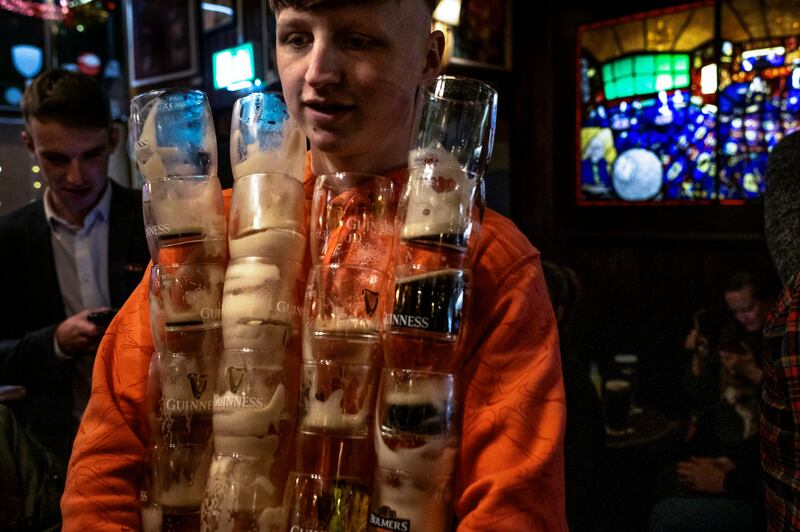


A ping announces the start of our descent. Forehead pressed to the oval window, I watch as Dublin’s ragged coastline comes into focus. First: the uninhabited island of Ireland’s Eye, an old Martello tower wedged like a thumbtack into the rocks. Next: the golf links at Portmarnock, edged with sand and marram grass; the poetically named Velvet Strand; the peninsula at Howth, a fist shadowboxing the bay.
Grass gives way to the intricate geometry of housing estates, north Dublin’s Nazca lines, and the nose of the plane tugs towards the airport. For a brief moment, all Dublin is laid out below me – the striped Pigeon Towers, the cranes of Dublin Port, the dull jade ribbon of the river Liffey – before another tilt brings the mountains south of the city into view.
Bray Head. The Sugarloaves, big and little. My home hill of Carrickgollogan, its profile like an upturned cereal bowl, the old lead mines chimney beside it, a ghostly spoon.
Home. I am home.
On Dublin / Reflections on the Irish Capital by Louise East, with photographs by Deanne Fitzmaurice, is published by The Little Museum of Dublin on Tuesday, February 10th and will be available to buy from littlemuseum.ie and in the Little Museum bookshop.


