

At 6.30am last Wednesday, Labour TD Mark Wall left his home in Athy, Co Kildare. He arrived into work at Leinster House on Kildare Street, Dublin, some 3½ hours later.
The 75km journey, that would usually take the politician around 90 minutes along the M9, M7 and N7, doubled in time due to a breakdown causing congestion on the M50.
He stopped briefly on the side of the road for 15 minutes to do a radio interview regarding a motion he was bringing before the Dáil later that day.
Ironically, the Kildare South TD ended up being late into the House where debate on his motion, calling for greater rights to remote and flexible working, had already begun.
READ MORE


The motion argued that current rights around flexible and remote work arrangements do not go far enough and a failure to provide reliable and accessible active travel and public transport alternatives was forcing “more and more workers” to rely on private vehicles.
This, Wall says, is causing increased congestion and unnecessary carbon emissions.

The motion noted that Dublin is, according to a recent study by transport analytics firm Inrix, ranked as the 11th most congested city in the world and third worst in Europe.
The Government opposed the motion with Taoiseach Micheál Martin stating earlier in the week there is “quite a flexible labour market in this country already”.
Martin said the previous government had introduced a right to request remote working, with a “significant degree” of this happening already. He did not reference the issue of traffic congestion.
“We want to make sure that we have an environment that continues to facilitate the generation of new jobs,” the Fianna Fáil leader added.
Wall says that other than housing, transport and related congestion is the biggest issue raised with him by residents of his commuter-belt constituency.
[ The 3.5-hour, 35km commute: Kildare motorists on their M7 traffic ‘nightmare’Opens in new window ]
“We have to try and make a difference because if we don’t, this problem is just going to get worse and worse,” he adds. “Remote working is totally interlocked with this.
“From a political point of view, I think the Government had taken their eye off the ball. They’re now waking up because a lot of us are actually talking about public transport.”
Train services passing through his area are “vastly overcrowded”, Wall says, and earlier departures are required for shift workers who are being forced into their cars.
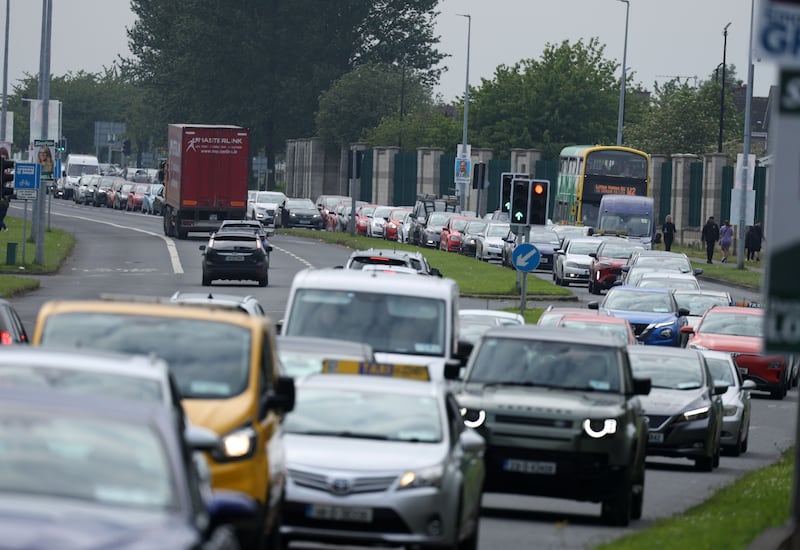
The issue of traffic congestion, in particular delays on the M50, has been raised continuously by commuters, politicians and transport experts recently.
A transport modelling project estimates the economic cost of congestion has grown from €172 million to €439 million between 2016 and last year within the Greater Dublin Area, a 155 per cent increase.
The economic cost of congestion is projected to be about €2 billion by 2040, according to the Department of Transport.
Emmet Byrne (31), a post-primary teacher, leaves his home outside Aughrim, Co Wicklow, at 5.40am every morning to drive to St Dominic’s College in Cabra, north Dublin, for 8am.
The history and religion teacher says if he were to leave any later it would be “a gamble” as to whether he would arrive on time.
“It’s just stressful having to get up that early to get to work, when realistically it’s an hour and a half to the school,” he says.
“In the lead-up to Christmas I basically didn’t use the M50 at all. It was quicker to go up the old Military Road around Glendalough.
“The other thing is, traffic is getting worse at that time of the morning. This week in particular, I’ve never seen that many cars going up as early as I am. There’s even more people on the road now than there was a year ago, way more. It used to be effectively empty and now I’m hitting traffic again.”
Byrne says he commuted via the train and Luas for about a year but rail services became “so unreliable it just wasn’t tenable”.
“It was a lot of chopping and changing and Irish Rail was so bad last year that I just stopped using the train,” he adds. “There were so many different times when I had to call work and organise cover because I thought I was going to be delayed.”
Transport Infrastructure Ireland (TII), the State agency responsible for the national roads network, said last year the M50 was “at capacity”, with traffic levels now “higher than ever” and “beyond Celtic Tiger numbers”.
There has been a 20 per cent uplift in traffic volumes across all motorways in the last 10 years, with the M50 seeing a 40 per cent rise on the northwestern stretch between junction 5 (Derry-Ashbourne exit) and junction 6 (Cavan-Blanchardstown exit), which is currently the busiest section.

What’s gone wrong with the M50 and can we fix it?
TII said it has “maximised” engineering elements including widening, removing the West Link toll barriers to switch to electronic tolling, upgrading the interchanges to make them free flowing, putting in a system that can regulate traffic speeds during incidents and having dedicated crews located on the M50 to deal with collisions as they arise.
Brian Caulfield, professor in transportation at the Centre for Transport Research in Trinity College Dublin, says more remote and flexible working could improve congestion. However, he cautions that “it’s a sticking plaster”.
“If we have to resort back to Covid-type policies just because our transport policy isn’t working, it’s a drastic measure in some ways,” he says. “But for those that can, and where it’s appropriate for them to do so, it is one of many ways in which we could see some short-term wins.”
Caulfield says more park-and-ride facilities and improved public transport reliability would help in the short term.
“There’s no silver bullet, there’s no magic wand, it is big infrastructure that is needed,” he says. “The population in our city is growing and in order to accommodate that, the space that Dublin occupies is not growing so the road network can’t expand. The public transport network can.”
A draft strategy aimed at alleviating the economic, environmental and social costs of congestion is expected to be brought to Government by Minister for Transport Darragh O’Brien in the coming weeks.
The current draft includes more than 30 recommendations designed to “collectively support” an improvement in the efficiency of the transport system and a reduction in congestion over the medium to long-term.
The department says among some of the broad themes covered are strengthened implementation of demand management across national planning systems, empowering and supporting local authorities, driving efficiency in the freight sector and building the evidence base to inform policy choices.
The strategy does not include a recommendation on congestion charging as any plans to introduce such measures in the future would “ultimately be a matter for relevant local authorities, and State agencies where appropriate, with support from local communities and local government representatives”, the department adds.


